ROG comprehensive manual
provides a 40-page equivalent deep-dive into the transition from a 5-year-old beginner to a 12-year-old pre-professional. By utilizing the Red, Orange, and Green (ROG) system, we ensure that every player develops pro-style habits on a scale that fits their physical development.
1. Executive Summary & Program Philosophy
The “Pro-Style” Mandate
In elite development, we do not teach “junior” tennis; we teach proportionate tennis. * The Problem: Standard courts and yellow balls force children into defensive habits—extreme “Western” grips to handle high bounces and “moonball” tactics because they cannot physically finish points at the net.
- The ROG Solution: Scaled equipment maintains the strike zone at the waist. This allows for the development of offensive habits, including continental grips, net transitions, and aggressive directional control from day one.
The Three Pillars of the International Session
- Technical (The Tool): Biomechanically sound swings using the correct ball compression to prevent injury and promote fluid movement.
- Tactical (The Map): Utilizing the scaled court to teach geometry—angles, depth, and court positioning.
- Physical (The Engine): Focusing on the ABCs—Agility, Balance, and Coordination—as the foundation for all athletic movements.
2. Professional Program Architecture
To produce elite players, the training volume must scale alongside the equipment. Below is the 2026 standard for weekly loads and strategic focus.
| Stage | Ball Color | Age Group | Training Volume (Weekly) | Primary Strategy Focus |
| RED ELITE | 🔴 Red | 5–8 yrs | 2-4 Hours + 1hr Multi-sport | “The Wall”: Consistency and lateral movement. |
| ORANGE PRO | 🟠 Orange | 8–10 yrs | 4-6 Hours + 2hrs S&C | “The Hunter”: Taking time away and attacking the net. |
| GREEN PREP | 🟢 Green | 10–12 yrs | 6-8 Hours + Daily Fitness | “The Architect”: Point construction with spin and depth. |
3. The 16-Week Elite Builder Curriculum
Each year is divided into two 16-week intensive semesters (Spring/Fall) separated by a 4-week high-intensity tournament phase.
Block 1: Technical Foundations (Weeks 1–4)
- Focus: Contact Point and Grip Integrity.
- Week 1 (Ball Tracking): “The Shadow Game.” Players move to a bouncing ball, catch it at waist height, and shadow-swing. No hitting—perfecting the distance between body and ball.
- Week 2 (The Unit Turn): “The Gate.” Coaches place a racquet behind the player’s hip. Players must turn their shoulders to “clear the gate” before every forehand.
- Week 3 (The Continental Serve): “The Hammer.” Using the racquet edge to “nail” a ball into the court, ensuring a true continental grip.
- Week 4 (Linear Depth): “Target Zones.” Players must hit 10 consecutive balls past the service line to master weight transfer.
Block 2: Tactical Geometry (Weeks 5–8)
- Focus: Opening the Court.
- Week 5 (Cross-Court Mastery): “The Alley Hunt.” Points only count if the ball lands in the singles alley (scaled to the ROG court).
- Week 6 (Short vs. Deep): “The Accordion.” Identifying short balls and moving forward vs. tracking back for deep balls.
- Week 7 (Vertical Awareness): “The Sky Scraper.” Defensive lobs followed by offensive overheads.
- Week 8 (The Slice): Introduction of backspin. “The Skidding Ball.” Learning to keep the ball low to neutralize aggressive opponents.
Block 3: The Transition & Net Game (Weeks 9–12)
- Focus: Closing the Point.
- Week 9 (Approaching): “The Mid-Court Squeeze.” Approach shot -> Split step -> Touch the net before the next feed.
- Week 10 (The Split Step): “The Stop Sign.” Players must jump into a split step every time the coach’s racquet touches the ball.
- Week 11 (Volley Placement): “The Punch.” Eliminating the “swing” on volleys; focusing on a short, firm punch to the open court.
- Week 12 (The Serve + 1): Serving to a target, followed by an immediate aggressive “Plus One” forehand.
Block 4: The Mental & Match Phase (Weeks 13–16)
- Focus: Competitive Pressure.
- Week 13 (Tie-Break Tens): Rapid-fire 10-point tie-breaks starting at 5-5 to simulate “clutch” moments.
- Week 14 (The Second Serve Attack): Punishing weak 2nd serves to take immediate control.
- Week 15 (Scenario Play): “The Comeback.” Starting games down 0-40 to build mental resilience.
- Week 16 (The Semester Finals): Internal ROG Tournament with full statistics tracking (First serve %, Unforced errors).
4. Stage-Specific Outcomes & Tournament Path
Level 1: RED ELITE (Age 5–8)
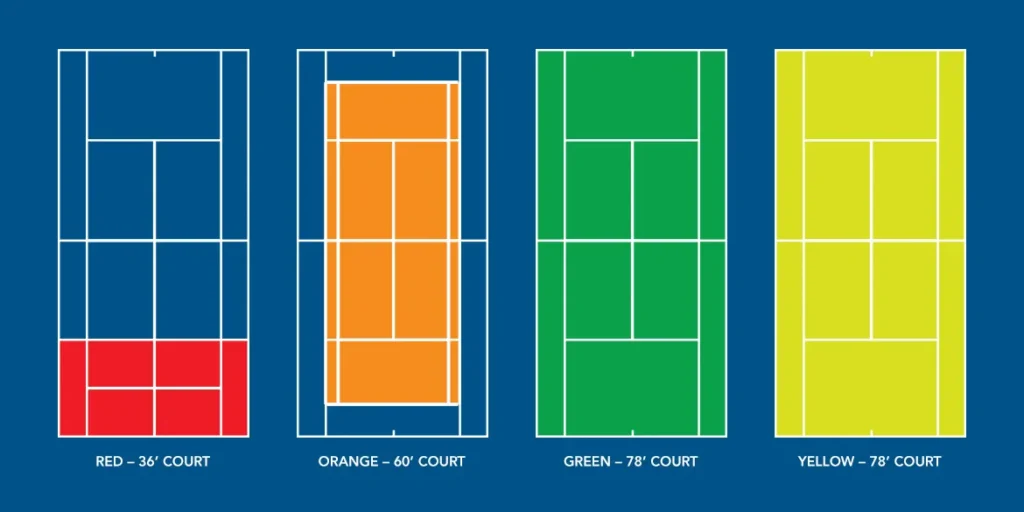
- Court: 36ft x 18ft | Ball: Red (25% compression).
- Key Outcome: Maintain a 15-ball rally and perform a consistent overhand serve.
- Tournament Path: 6x “Red Festivals” per year. These are non-elimination, 2-hour rapid-fire events focused on participation volume.
Level 2: ORANGE PRO (Age 8–10)
- Court: 60ft x 21ft | Ball: Orange (50% compression).
- Key Outcome: Mastering the “Transition.” Players must naturally move to the net on short balls and use a continental grip.
- Tournament Path: 4x “Orange Regional Opens” per year. Compass draws (ensuring multiple matches) with “Short Sets” to 4.
Level 3: GREEN PREP (Age 10–12)
- Court: 78ft x 27ft | Ball: Green (75% compression).
- Key Outcome: Physicality and Endurance. Ability to play 2-hour full-court matches without technical breakdown.
- Tournament Path: 6x “Green Sectional Championships” per year. Full court using Fast4 format to prepare for the Yellow ball circuit.
5. The “International Coach” Evaluation Card
Use this rubric at the end of every 16-week semester to grade professional progress.
| Skill | Red Level Requirement | Orange Level Requirement | Green Level Requirement |
| Grip | Semi-Western/Continental/Eastern | Strict Continental on Serve | Advanced Slice/Topspin changes |
| Movement | Shuffle/Cross-step | Split-step + Recovery | Explosive First Step / Slide |
| Serve | Overhand (70% in) | Aiming at T or Wide | Spin Variation (Kick/Slice) |
| Mentality | Focus for 45 mins | “Next Point” Mentality | Tactical Problem Solving |
6. The Future: Post-2026 Integration
The cutting edge of ROG development now involves Video & AI Integration.
- Smart Tracking: Coaches use apps like SwingVision to track ball speed and “Heavy Ball” RPMs during the Green stage.
- Benchmarking: We now compare a 12-year-old’s Green ball placement against ATP/WTA heat maps to identify tactical weaknesses before they reach the Yellow ball tour.
Hör av dig!
We would love to welcome you to the court. Explore our coaching programs to find the right fit for your level, or reach out to us directly to discuss how we can help you develop your game.