The heavy racket: Why “Play like it’s practice” is breaking junior players
It was a Tuesday afternoon in Spain, and the sound coming off her racket was like a gunshot. Thwack. Thwack. From the sidelines of the practice court, she looked unstoppable.
She was a highly promising junior player—relaxed, bouncing lightly on her toes, ripping heavy topspin forehands deep into the corners. She played with a kind of joyful arrogance that only comes when you trust your body completely.
Three days later, we were at a tournament, and that girl was gone.
As she stepped onto the match court, her shoulders crept up toward her ears. Her footwork vanished. Her racket suddenly looked like it weighed fifty pounds. She was pushing the ball, terrified of missing, paralyzed by the moment. She lost in the first round to a girl she routinely bageled in practice.
When she walked off the court, she didn’t even drop her bag before the tears of frustration spilled over.
“My dad keeps saying, ‘Just treat tournaments like practice,’” she said, her voice shaking. “But I can’t. It never feels the same. Why can’t I just relax?”
I looked at her and realized we had been setting her up to fail. “You can’t,” I told her. “Because biologically, it isn’t the same.”
The Biology of the Freeze
For months, we had been telling her to ignore the pressure. But that is scientifically impossible.
When a player steps into a tournament, the brain recognizes a high-stakes environment. Adrenaline floods the system, the heart rate spikes, and the amygdala shifts into a literal “threat state.” Telling a child to “just pretend it’s practice” is like telling someone in a storm to pretend it isn’t raining. Their body knows they are lying.
We had to stop pretending. If we couldn’t eliminate the pressure, we were going to build a system to harness it. We stopped trying to build a better forehand, and started building a complete Competitive Identity.
The Forge: Rebuilding the Competitor
The transformation didn’t happen by hitting more cross-court drills. We completely changed the environment.
First, we conquered the empty space. Tennis is a sport of micro-breaks. I noticed that during matches, the 20 seconds between points were destroying her. Her mind would spiral into panic. So, we installed a “Reset Ritual.” After every point, she had to inhale for four seconds and exhale for six—a biological hack that forces the parasympathetic nervous system to hit the brakes. We gave her a physical anchor: adjusting her strings twice to bring her wandering mind back to the present.
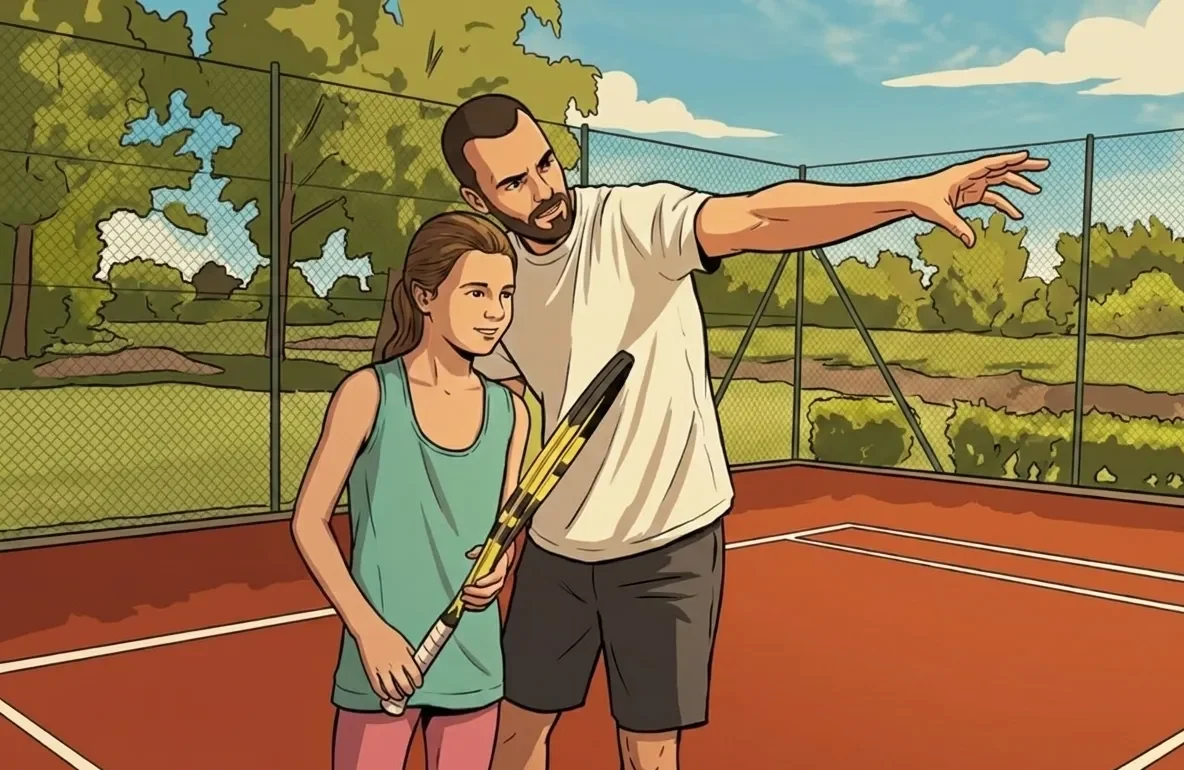
Next, we redefined what “winning” meant. Her tournament freeze came from a fear of the outcome—the fear of letting me down, letting her dad down, or dropping in the rankings. We stripped all of that away. I told her, “I don’t care if you lose every game. Your only job today is your body language.” We practiced keeping her shoulders back and her head high. We taught her to “fake it ’til you make it,” because walking like a champion actually sends chemical signals of confidence to a panicked brain.
Finally, we brought the tournament to the practice court. You can’t learn to swim on dry land. We started simulating adversity. I would make terrible, unfair line calls during practice matches. We played consequence sets where a lost game meant a set of grueling sprints. We artificially spiked her heart rate so she could practice finding her breath while her lungs burned.
The Breakthrough
It took weeks of messy, frustrating work. But then came the regional championships.
She dropped the first set of her quarterfinal match. The old version of her would have crumbled, packed it in, and cried in the car. But I watched from the fence as she walked to the back of the court. She adjusted her strings. She took a deep, deliberate four-second breath. She put her shoulders back, bounced on her toes, and walked up to the baseline looking like she owned the clay.
She didn’t just win the next two sets; she dominated them. She reached the semifinals—her best result in half a year. But the real victory happened when the tournament was over. She walked off the court smiling, completely regardless of the final score. She had finally learned how to fight.
The Playbook for Parents
If you have a child who is a “practice court champion” but a nervous wreck in tournaments, you have to change the narrative.
- The Car Ride is a Sanctuary: When they lose, do not turn the drive home into a lecture hall. Let it be a safe zone. Let them bring up the match when they are ready.
- Praise the Bravery, Not the Trophy: If they swing out on a big point and miss by ten feet, praise the courage it took to take the shot.
- Normalize the Nerves: Stop telling them to “just relax.” Tell them, “It’s okay to be nervous. That feeling isn’t fear; it’s just your body getting ready to fight.”